70 stories
·
0 followers

AI Mania Is Eviscerating Global Decision-Making

2 Comments and 4 Shares

Note: This has been cross-posted to my company's blog, in case you think there is some use in sharing with someone in a format that looks more authoritative. Link here.

I strongly believe there are entire companies right now under heavy AI psychosis and it’s impossible to have rational conversations with them about it. I can’t name any specific people because they include personal friends I deeply respect, but I worry about how this plays out.

Mitchell Hashimoto, of HashiCorp and Ghostty fame

Over the past year, I’ve run point on all of our company’s sales, led the technical components of all but two of our engagements, and over the lifetime of this blog have had something like 300 catchups with professionals from around the world. This has ranged from people on the ground in niche service industries to executives at Fortune 500 companies1. Because of this, I've had a front-row view to our collective institutions across both the private and public sector undergoing breath-taking mass psychosis. This essay is an attempt to describe the bizarre dynamics that are currently at play, as I am in the rare position where my wellbeing is not contingent on paying lip service to madness, and to reassure the people trying to survive amidst all of this that they are not crazy.

The reality is thus: the people in charge either have no plan, or see no path forwards other than keeping their heads down. Not at banks, not at hospitals, not in our government institutions. The world’s organisations have been captured by people in the throes of frothing excitement, and saner people who now live in a state of constant commingled fear and frustration.

I. AI Investments Are Generally Total Failures

Reading this while working for a division that pivoted to provide interfaces for agentic workflows, only to discover that only ten users had ever touched the products we made for agents, only to pivot again to support for agentic workflows, which has a lot of competition because every company has to do something agentic now and there's only like four things you can do in that space, is bracing.

– An editor of this essay

Are companies actually seeing massive productivity gains from their AI adoption? Does any of this sordid affair make sense?

This should be an easy question, but it is surprisingly hard to get a straight answer to it. Executives that tell the press that their company has gone insane will quickly find themselves removed from their positions. Employees who are honest will find themselves fired in short-order, or “randomly” selected for a round of layoffs. In fact, it is in the interests of almost every actor in the space – boards, executives, employees, vendors, consultants – to obfuscate and misrepresent the success rate of AI projects. Many publicly traded companies are putting out announcements about their AI productivity gains when I know for a fact that the businesses have done nothing other than purchase Copilot licenses and declare victory.

Yet we need to know if these projects are panning out – if the total focus on AI as a core tenet of business strategy is succeeding at a reasonable rate, then a discussion about the relative risk and reward is warranted.

Unfortunately, we live in a dark timeline. All of the AI projects we have observed as a team are failing. Every single one – we have seen 0% success in a year and a half, not only amongst projects we have been asked to participate in2, but even within projects that we have observed in passing while doing totally unrelated work. Even if you grant that AI tooling accelerates specific workloads, the method and scale of the current investments is senseless. Frequently the failure is not related to AI itself, but rather that companies are terminally bad at running software projects effectively, and as I have remarked previously, AI projects are subject to all the failure modes of normal projects plus you can get everything right and then still fail because of the method's novelty. Very few companies are so good at shipping software that they can afford the extra risk profile.

Often enough, though, it’s an actual failure in what LLMs can accomplish. The most common version of this, being rolled out across businesses around the world, is the internally-facing chatbot, or for the more daring company, the customer-facing chatbot. The story is always the same. For the former, I’ve never seen substantial internal uptake from inside a business. Employees don’t use internal chatbots because companies tend to have low-quality documentation and an LLM is not psychic – it can only know things that have been written down and made accessible. For the latter customer-facing applications, I have rarely had a pleasant experience as a consumer, with perhaps the exception of live transcription during medical appointments – hardly something worth pivoting an entire organisation around. In both cases, project leaders are very careful to avoid tracking basic metrics, such as whether the tools are being used at all, or they track metrics that are easily gamed.

For example, my last consumer interaction was attempting to get help from Mitsubishi following an automotive failure, where a very polite robot asked me to describe the problem and that I’d receive a call back as soon as someone was available. This was the single most competent implementation of such a project I’ve seen in the wild, in that the voice was natural sounding, responded quickly, was clearly “live” in production, and promised a swift resolution.

That was six months ago, and I did not, in fact, get a call back.

When Mitsubishi did not call me back, what happened? Did that request just go into the void, showing one less incident for the year? Does it appear that the phone bot resolved my query without the need for human intervention? All we know is that it didn’t show up as an error, or I’d have received a call. I’m sure it looks great in all sorts of ways except the one that matters, which is that I was planning to buy a car and decided not to buy another one of theirs.

For this reason, our team has quickly learned while on an engagement not to ask anything about ongoing AI projects in any context – by the time that project has started, it is too late for the management team, and intervention is not possible until a crisis point is inevitably reached. There is no conceivable positive outcome. The failure rate is so high that even basic inquiry leaves us in an untenable position. Any coherent question about how it’s going, what the goal is, who is using it, constitutes an inadvertent attack on the chain of command responsible for the work because there are no good answers to anything. Even in rare cases where my interlocutor has stated that things are going well (usually while the project is still mid-flight and failure has not had a chance to manifest), it is generally obvious that they are doomed, but at least in these cases I can simply agree and then go home to scream into a pillow for six hours straight3.

All of this is to say that I am very confident that almost every report at a company about “massive AI productivity gains” is untrue as a matter of brute fact. Even if some companies are seeing clear gains, this is the exception, not the norm. With that assumption in place, we can talk about the dynamics at play, and how it has become impossible for many organisations to stay focused on things that actually matter to their long-term (or even short-term) health.

II. Heretics Will Be Shot

It has become outright dangerous to even raise the possibility that AI might not be the solution to a problem, let alone be the sole focus of a company’s entire strategy.

In every sufficiently large business we have observed (say, with 500+ employees), we have noted that continued advancement, and increasingly continued employment, has started to require repeated professions of belief in the transformative power of AI for said business. I am not talking about providing ideas about how to use AI in the business – I mean religious profession, declarations of faith. Overwhelmingly these statements are made by non-technicians, though it is not uncommon for technicians to emit deranged statements to curry favour.

There have been several occasions where I have seen someone, apropos of nothing, blurt out almost word-for-word “AI is changing everything”, only to concede moments later that their organisation does not currently use LLMs for anything, and indeed, that they cannot name a single thing that has changed other than they get some use out of ChatGPT (frequently the free-tier). In one extreme case, I have seen an executive confess that they had never even used ChatGPT or any AI tool in their life, immediately after producing a technical strategy for an organisation with $2B+ in revenue which was entirely centered around AI.

Initially these statements were so absurd on their face that I thought it was some cynical ploy to achieve thought leader status, and there are certainly some people doing this – I have had it admitted to me. But the broader reality is so much worse: people who have no background in the technology at all actually believe what they are saying. As a general rule you should avoid getting into business with a liar, but if you must, you can at least reason with them even if only in private. A true believer is much more threatening because they are impervious to even inducement by self-interest.

The turning point in my belief was watching someone with a spectacular amount of money on the line fire their highest performers because they were achieving that performance without LLMs. When an employer publicly talks about AI innovation, we have to ask ourselves if they’re simply trying to manipulate the market or customers. When they privately commit to strategies like this with their own money at stake, with no attempt to communicate that strategy to external clients, I can only assume they really mean what they’re saying.

A while ago, I wrote “Contra Ptacek’s Terrible Article On AI”, which was focused on the fact that many of Ptacek’s points in his own essay “My AI Skeptic Friends Are All Nuts” were internally inconsistent4. But on the crux of the matter, we are actually in total agreement, because he opens his essay with this:

Tech execs are mandating LLM adoption. That’s bad strategy.

Which is to say that we can sidestep arguments about the precise utility of LLMs entirely and we’re left in a very simple place – it is entirely obvious to both myself and Ptacek, two people that are coming at this from fairly opposed views, that people are being really, really stupid about this, and that organisations are demanding bizarre workflow constraints from their specialist staff.5

These mandates have led to extremely strange places. Several of my peers now “AI-wash” their work, meaning that even when they can perfectly competently execute on their jobs to the satisfaction of their management teams, said managers are unhappy if the engineers haven’t used AI in the work… so now they’re lying about using LLMs even in contexts where their professional judgement is that they aren’t the appropriate tool. They just do the work, the same way they have for decades, and say Claude did it. Others are being measured on their AI bills with “token leaderboards”, where higher is better because I have evidently fallen into the pocket of Hell where the demons torment me by doing elaborate impressions of absolute fucking morons, so the people hired for their freakish ability to perform system optimisation do the obvious thing. They set the LLMs prompting themselves in a semi-plausible loop in case someone inspects the token consumption and then they watch Netflix. Not a single one has been caught, even when their own assessment of the output is that it isn’t suitable for deployment.

Checking out a parallel copy of our Go repository and telling the AI to rewrite the whole thing in Zig while I work on something else just so I can keep my job. I hate this shit so much. My job has usage tracking and quotas. I don’t use it for actual work, I just spin it up and disregard the output.

– An actual software engineer

In fact, the only people I know of to be fired over this whole thing are people that have expressed visible doubt about this organisational strategy, which again, even Ptacek thinks is transparently dumb. The net result is that everyone has learned very quickly to praise executives on their visionary AI prowess, or they will be gunned down in the proverbial streets.

III. AI Demos Are The Mind-Killer

Bless me, Father, for I have sinned. It has been ∞ days since my last confession. I accuse myself of the following sins:

One of the main pieces of infrastructure we deploy at our clients is an analytics-focused database called Snowflake – for a typical business, the bill is tiny because it’s a pay-as-you-go situation and we can process all their data in one minute a day, you get a very hands-off deployment, and in short it has many characteristics that are very pleasant for our work. One of the features in Snowflake that we don’t use is called Cortex.

Cortex is their AI chatbot layer, with the ability to plug into metadata (for non-nerds, descriptions of your data, like what a column in a spreadsheet means) and query a company’s database autonomously. In theory, you can ask a question like “What was our revenue for last week?” and it will spit out an answer.

It is not really suitable for production usage. From memory, the last time I was given a presentation on it, by actual Snowflake staff, they reported that ideal configuration results in something like ~92% accuracy due to the complexity of data at a large business (see: probably best-in-class for these tools, but imagine your CFO having one in every ten of their numbers be outright wrong) and there were serious issues with managing deployments. Nonetheless, it can be used to produce some very flashy demonstrations.

On several occasions, we’ve been exposed to folks that have been sort of lukewarm on our main offerings, but they really, really wanted to use AI to perform a natural language query on their data. And we thought “Okay, if you really want to see it, maybe we can caveat this appropriately and show you what it might look like.”

This was a terrible mistake. It backfired in the most predictable way imaginable – every lukewarm client that saw the chatbot in action, even with us telling them that it was not going to accomplish what they wanted, wanted to buy it immediately. Every other consideration, including millions of dollars that we could plausibly help them achieve by non-AI means, was swept aside. It was like a dark and terrible force seized control of their limbs, plunged their hands into their own chests, and presented their still-beating credit cards to us in grim supplication. We were so mortified by the inexplicable shift in energy that we (wisely) declined to take the money and ended the sales process, and soon thereafter removed Cortex from our list of demonstrations. It would have been too irresponsible to exploit this gap in their reasoning, and frankly, it was already irresponsible to have even run the demonstration – doctors don’t walk around showing off cool pills that they’d never prescribe.

Watching the total 180°, that shift from ice-cold to red-hot buying frenzy, was a deeply unsettling experience. It was personally uncomfortable to see people that clearly didn’t gel with us interpersonally suddenly dying to enter an ongoing relationship, but more broadly uncomfortable because for a brief moment I began to understand what is happening in sales meetings around the world. There was no warning I could have given that would have made them refuse to buy the damn thing – their appetite was as large as their budget could stretch, and some part of me wonders if this is because they knew that their ravenous hunger would be present in their own customers. They’d just buy it from us, then pivot right to a larger company and mind control their leadership team until the buck finally stops with the loser that needs to justify the expense. The main protection against this seems to be that the median vendor is so bad at their jobs that we had presented the first even somewhat-working products these people had seen, and this included an ASX-listed company that was already bragging about their AI usage. It took our team two hours to produce something that was frankly not that good – basically just typing text descriptions of data into a web browser – and it was still better than anything the leads had seen because they had nothing to show for all the investment.

In fact, we have been forced to opt out of every sale where the lead has expressed anything beyond the most fleeting curiosity in the use of AI in their business. I don’t mean that we’ve heard that they’re interested in AI and elected to drop the contract on moral grounds. I mean that, over the course of the engagement, these people have exhibited a pattern of behavior that has made it near-impossible to sell to them without incurring reputational and legal risk, and are furthermore crafting management environments that I can only describe as cultish, ineffective, and “please dear God, do not let it be on earth as it is on LinkedIn”.

IV. Executives, Game Theory, and The Emperor’s Clothes

The good news is, CISOs are used to having to protect the business from their hare-brained initiatives, and this one isn’t really that different, except that there’s a cult-like atmosphere to it that you didn’t see with, say, the cloud. It almost doesn’t matter whether you embrace the initiative or not; there’s work to be done to manage the risk, so that’s what you do. From talking to CISOs everywhere, I would say most of them are quietly skeptical but afraid to speak up.

– Career CISO and well-known speaker that asked to remain anonymous

Despite the substantial prevalence of true believers, many of the people running large AI initiatives, or making public statements about them, do not believe what they are saying. There are “heads of AI” who read this blog, at companies with $1B+ in annually recurring revenue, who have written in to say they believe their job is totally fraudulent but it was the only promotion pathway remaining at the organisation.

On a trip overseas, I had the privilege of a meeting with one of the Fortune 500 executives mentioned at the beginning of the post, who will remain anonymous so that they are not executed by firing squad by their board. As we were chatting, it became clear that they were very switched-on and technically competent, and they also happened to be at a company that had committed to the usual battery of exorbitant claims about their recent innovations – we’ve 100x’d our productivity, AI is the future of everything, I am but a vessel for OpenAI to make love to my wife. You know, normal things. But since I had them there without any microphones around, I asked why this was being repeated without opposition. Was it just sales fluff?

The answer was a lot more interesting. It was partially ridiculous sales material being delivered to an easily excitable audience, but this was not the dominant factor constraining honesty. Executives at their customers were saying absurd things about achieving 100x productivity, and this meant that if any executive at the vendor said that these gains were not plausible, it would undermine the credibility of the customer’s executive, be perceived as an attack (or heresy), and possibly result in an enterprise contract cancellation. And getting enterprise contracts cancelled because you wanted to opine on something that doesn’t really matter to your organisation’s mission is a great way to get fired.

But this company was also a major player, of the kind that signs enormous enterprise contracts with other companies. So presumably there is another vendor that has sold to them, and their CEO is worried that saying something sane will contradict this executive, and very quickly we can see how we can have executives around the world nervously pointing guns at each other, not wanting to be shot first but also watching everything gradually spiral out of control6. This is to say that we’re facing a coordination problem around executives being honest around the AI gains they’ve witnessed – if they co-operate, they keep their jobs. If they defect, they will possibly be fired by their embarrassed peers (who have now been implicitly called liars, cowards, or incompetents) and then replaced with someone that will toe the line anyway. If they could all admit the truth at once there might be some hope, but there is no way to coordinate that event.

This sounds deeply concerning, but it is worth noting that it means that some executives who are emitting nonsensical statements are not as dull as they might seem at first – they’re in a fraught political environment, where they are surrounded by many people that are gunning for their roles, and subject to the whims of a board that is undergoing similar pressure. Against all the dictates of reason, I have presented on navigating AI hype to people on S&P 500 boards7 and they are in exactly the same situation – the main comments I remember from the session were board members admitting they were skeptical, but expressing anxiety that their positions were contingent on demanding AI investment. One of them commented “investing this early seems like risk without much upside”. About two years later, I can see now that their decade-old multi-billion dollar organisation is now branded as “AI-native”, whatever the hell that means.

V. You Must Be This AI-Native To Ride

All of the above converges on the state that we find ourselves in now, where effective decisionmaking has ground to a halt. Collectively, what started as a few people undergoing either destabilising psychological events or being caught up in hype has now resulted in an environment where leaders cannot speak honestly about their beliefs on how best to guide organisations, for fear of being removed, creating a sort of distributed government by assassination. This means that the least sensible recommendations are going totally unchallenged, resulting in employees being evaluated on totally gameable metrics such as “money spent on AI”, and those employees must play along to avoid being terminated. This has also created an insatiable appetite for purchasing “AI” solutions, which target both true believers that will believe implausible claims, and also non-believers that cannot decline the purchases without having their commitment to the cause coming into question.

This means that all offers that are subject to internal politics at an ideologically captured organisation must include AI alignment, even if the value proposition is patently ambiguous. My assessment of the market so far is that a substantial component of the outburst of AI projects are actually non-AI projects with an AI element slapped on after the fact to pass the purity test.

For example, I recently witnessed an organisation handling a database migration from an Oracle database to Snowflake – instead of handling the migration directly, the vendor bolted on a preliminary phase which involved trying to get an LLM to automate the translation of the Oracle-flavored SQL to Snowflake-flavored SQL. When the project failed (due to issues getting enough permissions to automate the work, not because an LLM can’t do something that easy), the vendor simply started handling the translation by hand but the company billed it as an AI-driven success because some inconsequential portion of the SQL had been translated by AI before being pasted over.

What was actually purchased? A totally standard database migration to help an executive meet the strategic deliverable of decommissioning a system prior to license renewal. What was sold to their superiors? “I allocated a substantial percentage of my budget to AI and it helped me accomplish my mandate.” True AI projects, of the kind that is driven by an LLM as the sole mechanism underlying it, where the project can clearly fail to deliver specific numbers, are actually very rare. We mostly see them in the context of startups, and frankly we have stopped engaging with them because we kept getting to the end of the sales conversation and finding out they wanted us to build the product that they were marketing as completed.

However, some projects simply do not have an easy way to tack on the AI label, or the person advocating for them either does not want to lie or has not understood that lying has become necessary. In all cases, this either kills the request for funding outright, or adds a pervasive and intractable drag on all communications, as every request must be worked and re-worked until it is “AI enough”. Failure to comply will either result in denial or, in many cases, a demand from a true believer to know why the extra work “can’t be done with AI”. Many companies have actively publicized that this is their new hiring policy – when a member of staff requests additional headcount, they must demonstrate that they have tried to use AI first. The part that’s being left out is that if you say you used AI and still need the help, you will be labelled “bad at AI” and potentially laid off.

The net result of this is that almost every large organisation that I am aware of is no longer able to focus on anything important, unless they are one of the (very) few organisations where AI happens to address their highest priorities. They cannot buy sensible software, hire competent talent, communicate honestly with executives about the state of projects, or undertake any sort of sensible initiative.

VI. Navigating AI Mania

An emptiness falls through you
As you realize what this means
You're starting to feel what I feel
Now you've seen what I've seen

So Sick, Domesticated Incels

This is an unfortunate situation to be in, but it will pass eventually. I’ve learned a lot about the latent insanity that we have inculcated in our leadership strata, and unfortunately those traits will persist long past the current bubble, merely awaiting another similar reactivation trigger – and some organisations will stay captured until they have totally collapsed, in the way that not everyone has successfully moved away from the dreadful blockchain affair. That’s something to write about for another time.

What I wanted to get to were some thoughts on surviving the immediate crisis, either by directly making systemic improvements or by holding onto your sanity. I’ll start with the “making improvements” part, because that’s the situation I find myself in the most frequently.

When You Have Another Objective

We’re going to do a lot of sucking it up and smiling here. This section assumes that you are trying to achieve some goal that isn't repairing the organisation's manic stance, but either trying to course-correct a specific project (and possibly risk getting fired as either a leader or consultant) or achieve some totally unrelated goal.

  1. Where possible, when raising issues, do not have conversations about the state of AI projects in group settings, as this creates a dynamic where each individual member of the group is worried about outing themselves in front of their peers. Arrange for one-on-one settings. Make it clear that you are willing to countenance that the current AI environment is frothy, and that you will keep opinions unidentifiable when raising them elsewhere. Be extremely aware that the most outspoken people can be identified by their peers, so take care to avoid exposing your sources by, e.g. direct quotes. In the event that only a small minority (say, one person in a group of six people) is willing to speak out, it might be worth giving up and moving on to a patient that has better chances.
  2. For ongoing projects, an effective trick that I believe I picked up from Secrets of Consulting is the anonymous poll, where you can ask individuals to rate their opinion of an AI project’s success chances on a scale of 1 to 10. The typical split I have observed is half of those involved rating the project at a 3/10 and others at around an 8/10 – a clear bimodal split on a project that was already three years late. Bringing this data to a CEO can be an effective method of pointing out that some information is clearly being hidden from them on the state of the project.
  3. Always involve people on the ground. The only source of data on whether projects are succeeding or the investment is going anywhere are the people that use it for their day-to-day activity. Care must be taken to bring them into the environment where they are treated with respect (all sufficiently large companies have people that view subordinates as not-quite-real-people). It is not uncommon to uncover worldview-shaking information in short order – with one client, we uncovered that staff were totally unaware they had been given licenses for AI tooling, which cast into doubt all productivity claims.
  4. Do not question the broadest claims about AI. I cannot emphasize this enough. If someone says “AI is changing everything”, just let it pass if your goal is to fix an object-level problem rather than challenge the reality at the institution. The challenge can only come after you have gained the trust of the most senior person involved. Trust is gained over a meal in private where you assuage their anxieties, not by embarrassing them in front of peers.
  5. Remember that you do not know what statements have been emitted prior to entering a room. There will sometimes be people that have publicly committed to statements like “I am 100x more productive than I was last year”, and some may even wish they hadn’t said that but are too embarrassed to walk it back. In an untested room, common sense like “LLMs should not be allowed to deploy code without human review” can kill your chances to make an impact before you’ve even started.
  6. My practice requires me to maintain an honest relationship with my clients or the whole thing falls apart, so I can’t do this – but honestly, if you work in the fire service and need money to stop a puppy from catching fire, just lie. It’s fine. History will forgive you. Add a $10,000 AI chatbot to your project, exclusively discuss that part in meetings, whatever. Save that puppy.

When You're Just Trying To Survive

This is for people that are just waiting for the bubble to burst and trying not to go nuts.

  1. I have bad news – accept that you are probably not going to meaningfully push back on any of this. This is not a feature of AI, it’s a feature of dysfunctional companies.
  2. If you feel like you’re going absolutely nuts, consider switching over to contracting. I’ve advocated for contracting many times over full-time employment, but you’ll get paid a lot more and be left out of most internal politics. Also when you run into a really intolerable situation, you’ll know that you’ve got a fixed end-date.
  3. I do my best to limit my uptake of AI-related news, as it is pretty crazy-making and unproductive to consume. I no longer visit Hackernews, Reddit, or really anywhere where I am going to be drip-fed nonsense, though I allow myself exceptions for very funny things like Apple suing OpenAI over alleged corporate espionage. Consume exactly the amount you need to feel like you aren’t going insane, then stop. Ditto for complaining with friends – and tell them that’s why you’re talking about it, which buys a lot of tolerance.
  4. When someone tells me they are using AI for something when they really shouldn’t be, I smile and nod as long as they are unlikely to get themselves killed. Even family. Especially family.
  5. When someone asks me for my opinion of AI as a programmer, I recommend saying “Oh, that stuff is pretty overblown” and then changing the topic, unless they are in a position where their opinion might influence something important. Non-programmers need this guidance the most.
  6. If you’re being asked to review huge volumes of terrible AI code, just assume that the organisation is going to burn you out and fire you. You will not convince the person drowning you in 2000 line PRs to stop. Start looking for a new job as if you have already been fired. I have seen this happen many times now, and it always plays out the same way – do the job search while you have energy. Don’t worry if your speed drops or management gets annoyed at you. There is no way to avoid that, you can simply choose whether it happens now because of your job search, or later because you are too depressed to work anymore.
  7. If your manager is responding to you with clearly AI-generated text, use AI to respond to save your sanity and then look for a new job. Many people assume they will get in trouble for being that obviously rude. You will not, this particular behavior is exhibited only by true believers, and they actually like that you’ve clearly not bothered to engage with them. I know, it’s fucking wild.
  8. If you’re being asked to max out on token usage, look for a new j – okay look, you get it, right? Go find a job that isn’t going to wrench reality from your tenuous grasp. They do exist, largely at companies so small that they don’t turn up on job platforms. It might take months to find one, so start now.

Fight the good fight, and don’t let the bastards grind you down. Godspeed.


  1. Also, and this is 100% true, Matt Mullenweg once asked me for coffee because he read the AI piledrive essay, and in context probably enjoyed it, but had to cancel because he hadn’t realized he had a flight later the same day. I am willing to pay a competent witch to hex him for this slight. 

  2. We have rejected all AI implementation work. It is absolutely a gigantic bubble and we have minimized our exposure to it – every single one of our current contracts would be totally unaffected by OpenAI collapsing, save for perhaps some second-order effects such a recession causing a client to become unable to pay us. And there’s nothing we can do to insulate ourselves from that anyway. 

  3. One of the most valuable rules I’ve heard, from Gerry Weinberg, is that consulting is influencing people at their request. Unless someone has indicated that they want us to stick my nose in, usually by explicitly saying they want guidance on general data strategy, we just let the projects fail in peace. You can barely recognize me, I’m so calm these days. 

  4. We have since kissed and made up in private, though I don’t think we’ve budged at all on the core points of our viewpoints. I maintain that Thomas is a very talented writer with a lot of good advice who just happened to blow it massively that one time because he takes Hackernews commenters too seriously. We all have our weaknesses. Mine is people telling me that “Scrum is good if you do it right”. 

  5. This is always baffling to me as a matter of being a responsible adult. If I was somehow CEO at a hospital or civil engineering firm, I would not for a second think it’s my place to start mandating specific procedures or building techniques without explicit agreement from the professionals on staff – how fucking clueless are the non-technicians who have attended a few talks and are now making mandates about how their extremely expensive professionals are doing their jobs? 

  6. If you’re an executive, board member, or anyone in charge of an “AI project” that feels trapped, I would love to hear from you. I will file the serial numbers off any stories very carefully, as I’ve done here and in every other article. 

  7. This sounds very fancy, but I think it was secretly one of those compulsory professional development things and half the audience were just like, making dinner. Truly, HR and professional bodies make victims of us all. 

Read the whole story
williampietri
3 days ago
reply
Great for the content, but also a stellar example of how to structure your income if you want to be honest on the regular.
tante
6 days ago
reply
"I strongly believe there are entire companies right now under heavy AI psychosis and it’s impossible to have rational conversations with them about it."
Berlin/Germany
Share this story
Delete

Scientists Think They’ve Uncovered the 15-Million-Year-Old Origin of Laughter

1 Share

Welcome back to the Abstract! Here are the studies this week that yucked it up, went interstellar, controlled the weather, and sang our praises.

First, the sounds of ape laughter have been gracing our planet for 15 million years. Then: a visit from a cosmic elder, a meteorological martial art, and bops by blowhards. 

As always, for more of my work, check out my book First Contact: The Story of Our Obsession with Aliens, or subscribe to my personal newsletter the BeX Files

A history of hominids in hysterics

De Gregorio, Chiara et al. “Rhythm and timing in laughter reveal that human vocal plasticity falls on a hominid continuum.” Communications Biology.

You’ve heard about getting the last laugh, but who got the first one? Scientists have now determined that laughter, a behavior common to all great apes, may have initially appeared in chortling primate ancestors that lived 15 million years ago, according to a new study that analyzes the evolutionary roots of getting the giggles.

In addition to being the best medicine, laughter plays an outsized role in human cultures and interpersonal relationships. The fact that all other great apes, from bonobos to gorillas, also enjoy a good chuckle suggests that this form of vocal expression has broad benefits and potentially deep evolutionary origins.

To probe the history of hilarity, scientists analyzed recordings of laughter from four orangutans, two gorillas, three bonobos, four chimpanzees, and four human children during bouts of playtime, roughhousing, and tickling. 

The results revealed that the isochronous nature of laughter—meaning clear sound intervals like “ha ha ha”—was likely present in the last common ancestor of the Hominid family, which contains all great apes including extinct relatives such as Neanderthals.

“While all major branches of the Hominid family have evolved distinct call repertoires shaped by their species-specific socio-ecologies, one vocalization has been conserved across species and age-sex classes: laughter,” said researchers led by Chiara De Gregorio of the University of Warwick.

The team’s analysis reveals that “great apes have been laughing in a recognizable way to modern humans for at least 15 million years” and that apes that are more closely related to humans have more complex and variable laughs similar to our own diversity of guffaws, cackles, and snorts.

To sum up: lol…lmao.  

In other news…

A long time ago in a star system far, far away…

Cordiner, Martin et al. “Isotopic Evidence for a Cold and Distant Origin of 3I/ATLAS.” Nature.

The interstellar comet 3I/ATLAS caused a sensation last summer when it was first discovered streaking through the solar system, partly because it revived the debate over whether these objects from other star systems could be alien handiwork.

While the evidence overwhelmingly suggests that 3I/ATLAS is not an extraterrestrial spaceship, it is nonetheless unlike any comet seen in human history. Scientists have revealed that the comet is by far the oldest object ever detected in the solar system, having “accreted as long ago as 12 billion years, following a period of intense, early star formation,” according to researchers led by researchers led by Martin Cordiner of the Catholic University of America.  

In other words, 3I/ATLAS is nearly three times older than the solar system, formed when the observable universe was only a third of its current size. The age is based on the comet’s ratio of deuterium to hydrogen (D/H), which was measured by the James Webb Space Telescope, the most powerful observatory ever launched. 

JWST revealed a “surprisingly high” ratio of deuterium enrichment, about 30 times the level of solar system bodies, with the exception of Venus. “3I/ATLAS thus represents a preserved fragment of an ancient planetary system,” concluded the team. 

So long to this primordial pilgrim, and may it live to be 13 billion. 

I have a black belt in hurricane deflection

Huang, Qin et al. “Weather Jiu-Jitsu: Prospects for atmospheric nudging to defuse the impact of catastrophic weather extremes.” PLOS Water.

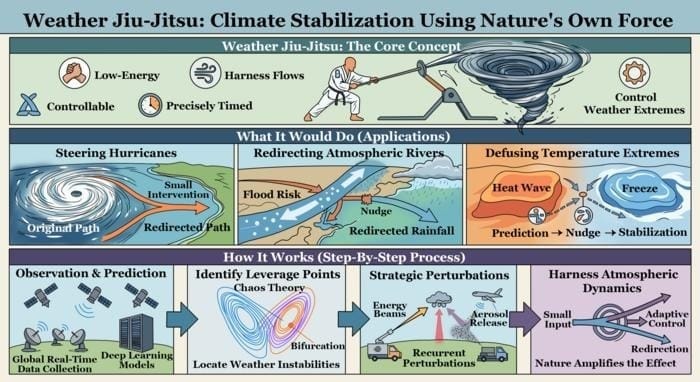
Finally, we have an answer to the age-old question: Can we use martial arts to control the weather? In a new study, scientists propose the concept of “weather jiu-jitsu,” which uses gentle atmospheric “nudges” to redirect potentially catastrophic weather events, such as hurricanes, heat waves, or droughts.

“Imagine harnessing the power of nature to help steer hurricanes away from land, redirect atmospheric rivers to spread their rain safely and evenly, or defuse extreme weather patterns like heatwaves, freezes, or prolonged droughts before they take hold,” said researchers led by Qin Huang of Arizona State University. “It’s a vision where we partner with Earth’s own forces to create resilience, rather than reacting to disasters.”

Conceptual illustration of weather jiu-jitsu. Image: Qin Huang, Moyan Liu, Upmanu Lall, CC-BY 4.0 (https://creativecommons.org/licenses/by/4.0/)

Weather jiu-jitsu involves seeding clouds with particles to influence weather outcomes, but it differs from existing methods by opting for light touches in advance of a developing weather event, as opposed to the heavier lift of weakening an event that is already ongoing.

The team’s models suggest this method could have nudged Hurricane Sandy well away from New York City in 2021, warmed Texas by about 18 degrees Fahrenheit during its deadly 2021 freeze, and reduced the rainfall that caused widespread flooding in California from 2022 to 2023 by about 5 percent. 

That said, the study emphasized that the technique is only a proof-of-concept and it will take far more research to determine if it would be useful in the real world. In the meantime, let’s try some other martial arts-inspired approaches and figure out how to crane-kick a tornado or karate-chop a heat dome.

I bet you think this song is about ME

Golubickis, Marius et al. “Are societies becoming more self-centric? Evidence from five decades of popular music spanning three continents.” PLOS One.

While the Song of Summer 2026 has yet to be determined, odds are that it will be singularly self-absorbed. That’s the hook of a study that discovered popular music has shown “a significant increase in self-focused language over time in individualistic societies” such as the United States or Germany, while no comparable trend was observed in more collectivistic societies such as Japan or Hong Kong.

Are societies becoming more self-centric? Evidence from five decades of popular music spanning three continents
Mean use of first-person singular pronouns as a function of Year and Country/Region. Image: Golubickis et al., 2026, PLOS One, CC-BY 4.0 (https://creativecommons.org/licenses/by/4.0/)

Scientists led by Marius Golubickis of United Arab Emirates University analyzed the lyrics of top 10 hits from 1970 to 2019 by quantifying the use of the plural pronouns like “we” and “us” compared with the first-person singular pronouns like “I” and “me” (check out the full list here). The results revealed that while “Western societies exhibited a clear increase in self-focused language over time, East Asian societies showed relative stability.”

This all checks out with my go-to playlist for narcissists, featuring “I Me Mine” by the Beatles, “Me Myself and I” by De La Soul, and, of course, “ME!” by Taylor Swift.

Thanks for reading! See you next week.


Read the whole story
williampietri
29 days ago
reply
Share this story
Delete

A Bit of Tedious Drama At Bluesky

1 Comment and 2 Shares

Recently I got suspended for four days from Bluesky for posting this:

My suspension is over now. But I believe that returning after a suspension carries with it an implicit promise that I won’t post that, or something like it, again. I won’t make that promise, so I won’t return to Bluesky.

Regarding Suspension

I’ll talk about what I said and why I meant it. But before that, I have three points about being suspended.

First, I’ll repeat what I’ve said many times: Bluesky and other social media platforms can suspend or ban whomever they want for whatever reason they want. Bluesky’s moderation policies are an expression of its free speech and free association rights, as surely as my decision what to post there (or whom to block there). I may think their expressive choices are stupid, but I think a lot of people’s expressive choices are stupid, and so do you. It’s their right.

Second, I have no idea whether this suspension represented a human being’s decision. Bluesky uses automated moderation because it has to. Bluesky couldn’t use human moderation without charging everyone a ludicrous amount to post on Bluesky. I firmly agree with Mike Masnick’s long-standing rule that good content moderation is impossible to do at scale. A number of twerps and anti-anti-Trump mediocrities pretended to be exercised over the post; there’s a good chance that some sort of mass report campaign resulted in an auto-suspension almost two weeks after the fact. I submitted an “appeal,” which may also have been evaluated by machines, or maybe not. It really doesn’t matter: either humans decided on the suspension, or decided not to lift it, or decided to create the system that imposed it automatically.

Third, I’m not a victim. Don’t cry for me, Bluesky. I said what I said deliberately, knowing the risks. I will miss the parasocial relationships with many cool people, but some of those will be rebuilt elsewhere. It’s social media, not life. Moreover, I’m fortunate. I have lots of channels to express myself. I am in a far better position than the average Bluesky user who gets banned for lashing out — most often, lashing out at transphobia, or racism, or other stuff. Bluesky has a moderation mindset (or at least a moderation AI) that views some rando saying “the world would be a better place if Elon Musk were not in it” as being far worse than Elon Musk and people like him encouraging violence and pogroms. I knew what I was getting into.

Regarding Elon Musk and His Ilk

Now, I’ll address the substance of what I said. I meant every word. Moreover, I was right, and most of the outrage is contrived, dishonest, and in bad faith.

The context for the statement was Elon Musk’s ongoing efforts to use Twitter — his extremely powerful and influential toy, the algorithms of which boost his every thought — to incite racial violence against immigrants in the UK. This is not unusual. Elon Musk regularly encourages, by his own posts or boosting other posts, that the right people should use violence against immigrants and against race-traitor whites.

I could argue this point — try to persuade you — but it’s pointless. The possibilities are these: you already know and you’re appalled, you already know and you support it, or you’ll never be persuaded, any more than a Trump supporter can be persuaded that the 2020 election wasn’t stolen.

The other crucial context is that the current leadership of the United States is increasingly intent on promoting white nationalist hostility and clash-of-civilizations narratives to encourage hatred of immigrants everywhere. Whether it’s Pete Hegseth comparing immigration to the D-Day invasion or Trumpists promoting the noxious Camp of the Saints or the administration turning official social media channels into fonts of Nazi iconography, the Trump Administration supports and promotes the same racial narrative as Musk. Once again: either you know it and hate it, know it and love it, or will never acknowledge it.

Elon Musk is the world’s richest man — a trillionaire, briefly, until a market correction. He and his ideology are also supported by the administration of the most powerful nation on Earth. He is immune to normal social, economic, political, or legal limits. He can use his hugely influential platform to encourage pogroms without social, economic, political, or legal consequences.

It’s simply factual to say, as I did, that the only thing that will stop him is dying. Because my medium was a short Bluesky post, I mentioned him being killed. I suppose it would also stop him if he overdosed on Ketamine or choked on a piece of steak or got ass cancer or crashed one of his vehicles or something. But that would make a long post. Though the post has drawn plenty of criticism, nobody has explained to me how I am wrong about the limited circumstances that will stop him from encouraging racial violence.

No, mostly people are upset at the more pungent coda — “If only.” I said that because I think the world will be a better place when Elon Musk — sociopathic trillionaire who wants to watch a race war — is dead. I suppose it would be better if he dies from the ketamine thing. Political violence tends to lead to more political violence, political violence tends to hurt the powerless disproportionately, and political violence is destabilizing — though not, I think, as destabilizing as a politically connected trillionaire using his powerful social media platform to urge genocide. Elon Musk is autistic trillionaire Radio Rwanda.

I find the pearl-clutching over this sentiment profoundly unpersuasive. The United States kills people who “need killing” all the time. We’re on a campaign of killing unidentified guys in boats in the Gulf of Dementia because the government claims they’re drug dealers. We execute lots of people, many of whom did what they were accused of, many of whom have IQs above 70. We shoot protesters. We shoot people on the very thin pretense that they were “threatening” police officers. We kill Iranians — military and civilians — and boast about how we’re going to kill more. We killed Yamamoto and it’s a good thing we did. We didn’t kill Hitler but we helped arrange the circumstances where he killed himself, and nobody shook a scolding little finger at anyone for wishing him dead. Our most popular Founding Father’s most popular quote is “the tree of liberty must be refreshed from time to time with the blood of patriots and tyrants."

Now, I think people of good faith can disagree about the morality or utility of wishing other human beings dead. I’ve read a few comments that suggest reasoned opposition. But not many. The loudest cries of outrage are from people who will diagnose you with Trump Derangement Syndrome if you object to the ocean of blood I just described. The reaction is largely contrived, mostly in bad faith, and rarely to be taken seriously. The people landing hardest on the fainting couches are in two groups: pro-Trump people who are thrilled that we are extrajudicially executing fishermen in the Gulf, and professional grifters who don’t necessary like the extrajudicial killings but whose entire gimmick is “aren’t those leftists silly and outrageous.” Look, they need to make a living, and they have to base a personality on something.

Pro-Trump people want you to think this oceans of blood and paeans to genocide are all good and praiseworthy, because those are their values. The anti-anti-Trump crowd wants to mock objections to Trumpism, because their dearest value is grift, and they think cringe is worse than fascism. They both demand to be taken seriously, to be respected. I decline. I said what I said.

Bluesky had the right to suspend me for that. I just think they were petty and dumb to do it.

A Postscript Regarding Honesty And Openness

I’ve made an effort for years to be open and honest about things like depression and anxiety, because I know it’s healthier, and because the social stigma around it should be crushed. This incident resulted, as is often the case, in losers mocking me for being crazy, and slightly more pretentious people obliquely referring to my mental heath. This is how I actually discovered, to my shock and pity, that Twitchy still exists and thinks mocking my mental health is worth two whole posts. Again, these people have to eat, I guess. But here’s my point: it turns out that the only people who do it are assholes, the only people who buy it aren’t worth your time, and it doesn’t really make an impact on your life. So be open and honest about mental health, speak up when you need help, and don’t spare much worry for the rabble. You’ll be better for it.

Now, back to rambling through the Cotswolds.

Read the whole story
williampietri
31 days ago
reply
In crazy times saying sane things get you treated as if you were crazy.
Share this story
Delete

AI and Teaching – The Brave New World

1 Share

This article previously appeared in the Entrepreneur & Innovation Exchange (EIX)

This is the 16th year we’ve been teaching the Stanford Lean LaunchPad class. This year, from the first hour of the first class, we realized we were seeing something extraordinary happen. It was both the end and beginning of a new era. 

Teams showed up to the first day of class with MVPs (Minimal Viable Products) looking like finished products that previous classes had taken weeks or months to build. After the class, as the instructors sat processing what just happened, we realized there’s no going back. 

I’ve been writing about how AI is going to change startups, but the shock of seeing 8 teams actually implementing it was mind blowing. And not a single team thought they were doing anything extraordinary.  


Class Observations: Product Development Velocity is Off the Scale
The old sequence for our class was simple – we had teams replicate what they would do in a startup. Have an idea. Build a team. Get out of the building to talk to customers to understand their problems, do Agile development and DevSecOps to build Minimal Viable Products (MVPs) over 10 weeks to test the solutions. And if they were going to build a company, discover and  develop a “moat” of proprietary code and features.

This year, in the first week of the class our students used multiple AI tools to replace what previously would have taken a large development team. They used Perplexity and ChatGPT for research, Claude Code and Replit to build apps, Vercel/v0 for prototyping, Granola to auto-transcribe and summarize customer interviews. The whole flow was compressed.

Because it was so easy to have an idea and then build something in minutes/hours, our students showed up on the first day of the class with products. They no longer had to wait weeks or months before testing whether anyone cares.

What we realized we were watching was a massive acceleration of the Customer Discovery / Customer Validation timeline. 

Learning 1. Impedance Mismatch Between Product Development and Learning
By the third week of the class we observed that the velocity of product development meant that teams could now generate more products than they could validate. The amount of product did not equal the amount of learning. Teams were so overwhelmed with so much information from the AI tools that they lost sight of the goal of customer development. They started to believe that the product itself was the truth.

Consequence 1. AI has made Customer Validation Harder
The abundance and ease of creating MVPs has become an accidental denial of service attack on the search for a repeatable and scalable business model. While this is an artifact of today, it means we need a different model for Customer Development as rapid coding isn’t going away.

Learning 2. Student Dependence On ChatGPT Decreased the Quality of Insights After week two of the class, it was clear teams were delegating communication to an AI. This dumbed down communication turned into AI slop. ChatGPT and Claude are no substitute for thoughtful communication – whether it’s email, PowerPoint or weekly summaries of Lessons Learned. Luckily you can spot this quickly.

Learning 3. Customers are Feeling Disrupted
As the student teams got out of the building, they discovered that potential customers were already feeling disrupted by AI. Many of the companies the teams demo’d to realized that they were seeing not just incremental improvements, but in fact were being shown a “going out of business” scenario.

Learning 4. Customers realize their proprietary data might be their only moat
In some cases, potential customers who would have previously shared their data with students are now asking for NDAs to share information with the team. Customers are realizing that closely held and hard-won information might be one of the few barriers to AI.

Potential 1: Customer Co-Design
As AI tools are allowing our teams to build higher fidelity MVPs, a few are beginning to consider using the MVPs as digital twins (as a simulation of the final product.) When put in the cloud and shared with potential earlyvangelists, startups can now start co-designing the product with potential prospects.

Teams can monitor if the digital twin is being used, how it’s used, and the feedback of what features are needed can be shared instantly. Teams can update the digital twin as they add features.

Potential 2: Agent/Customer Outcome Fit
Today, software applications are built to give users information and then expect the users to do the work via a user interface of dashboards, alerts, workflow tools and reports. But customers buy software to get a job done, not to look at more screens. Getting the job done is what AI Agents (orchestrated by tools like OpenClaw) will autonomously enable. For some teams, future class sections may see the search for Product/Market fit become the search for AI Agent/Customer Outcome fit. Minimum Viable Products (MVPs) will become Minimum Productive Outcomes (MPOs.)

Lessons Learned

  • MVPs are No Longer an Indication of Technical Competence
    • Vibe coding has transformed MVPs to the equivalent of PowerPoint slides
  • Speed to MVPs Hasn’t Yet Meant Faster Learning About Building a Company
    • While we’re still early in the class, the blinding speed of the first week’s onslaught of MVPs hasn’t yet translated into faster learning about customer validation.
  • Business Process and Business Models Still Matter
    • The bottleneck for our student teams has moved from needing the resources to build high-quality MVPs to judgment: how to choose the right problem, how to read user signals correctly, and deciding what to build next.
  • Product/Market Fit and Agent/Outcome Fit Will Co-Exist (for a while.)
    • While some customers are ready to move to an Agentic workflow, for others delivering Product/Market Fit is still what users want to see.
  • Startup Teams Will Be Smaller
    • Our class teams are 4-5. In the past, if they decided to pursue their idea and start a company they would need to hire a larger team to build the product, manage the product, find out whether they had product/market fit, create demand, etc. That’s mostly no longer true.
    • Most teams won’t need to raise money to find out if the problem is real or before they know if users care.
  • Enterprise Pricing Models Will Change
    • Some teams are already testing pricing that will shift from per/seat to workflows, outcomes, results, resolutions, successful task
  • Customer Development Will Change
    • Because the Customer Development cycle is faster and multiple MVPs now can be run simultaneously…
    • Effort shifts to the extra time needed on hypotheses testing because the velocity and volume of product development can overwhelm signals from potential customers
    • As MVPs rapidly change, they need to be instrumented to monitor customer usage/interactions

More Learning In the Weeks Ahead

Read the whole story
williampietri
95 days ago
reply
Share this story
Delete

When War Crimes Rhetoric Becomes Battlefield Reality: The Slippery Slope to Total War on Iran

1 Share

“Tuesday will be Power Plant Day, and Bridge Day, all wrapped up in one, in Iran. There will be nothing like it!!!” posted President Donald Trump on Easter Sunday. In case one thought that was an impulsive utterance, it’s notable that the president in apparently prepared remarks a few days earlier said, “If there is no deal, we are going to hit each and every one of their electric generating plants very hard and probably simultaneously.”

Such rhetorical statements – if followed through – would amount to the most serious war crimes – and thus the president’s statements place servicemembers in a profoundly challenging situation. As former uniformed military lawyers who advised targeting operations, we know the presidents’ words run counter to decades of legal training of military personnel and risk placing our warfighters on a path of no return. 

Iranian power plants and other critical civilian infrastructure are protected from attacks by the law of war the United States helped craft after World War II. Such an object can lose its protection only if it is used for military purposes by the enemy and its destruction “offers a definite military advantage.” Even then, such an object can be attacked only if, after a case-by-case rigorous analysis, the “concrete and direct military advantage anticipated” outweighs the civilian suffering that is expected to result. (Geneva Convention Additional Protocol I art. 52, art. 57; DOD Law of War Manual, § 5.6, § 5.12).

Despite those well-settled legal parameters, President Trump has repeatedly threatened to obliterate such infrastructure without regard to the law’s high demands. His comments are blatant expressions that he is willing to turn the United States into a rogue State like Iran and Russia, one that rejects the fundamental legal restraints that protect innocent non-combatants like children, and the Iranian civilian population itself. 

Effects on Servicemembers 

While our Commander-in-Chief threatens to “obliterate” “each and every one of their electric generating plants,” U.S. military commanders have been approving strike packages, wrestling with how to transform Trump’s dangerous bombast into lawful targets. 

Asking our military professionals—lawyers and commanders alike—to grapple with the president’s erratic behavior is enormously consequential.  U.S. military commanders have sworn to obey the Constitution and only those orders from their superiors that are lawful.  Threats to bomb Iran “back to the Stone Ages” and to show “no quarter, no mercy” are plainly illegal.  Trump’s outrageous statements gravely threaten our military professionals’ bedrock moral and legal principles, ones enshrined in the law of war that they’ve been trained to follow their entire careers.  

We write to highlight that the Commander-in-Chief’s dangerous rhetoric  places our service members in an intolerable position in several respects.  

  • First, such threats undermine U.S. legitimacy and global standing, as they demonstrate a rejection of binding international agreements and core commitments to the laws of war. Indeed, the U.S. military doubled down on its commitment to the law of war following Vietnam War-era atrocities, requiring our Armed Forces to follow the law regardless how any conflict is characterized. An operation that followed through on Trump’s rhetoric would be one of infamy in the history of modern warfare. 
  • Second, they pose a significant risk of moral and psychic injury for servicemembers.  National soul-searching regarding how Americans fight followed the long U.S. wars in Afghanistan and Iraq, in which both civilian casualties and detainee abuse undermined strategic objectives and weighed heavily on soldiers’ consciences long after the fighting stopped.  This reflection led to initiatives such as the Pentagon’s civilian harm mitigation program and new laws regarding detention and interrogation practices, strengthening U.S. commitment to fighting honorably and effectively through adherence to the law.   
  • Finally, the public record of intent to commit war crimes puts soldiers at risk of later liability. In any future war crimes or U.C.M.J. investigation—for which there may be no statute of limitations—their actions will be judged based on the reasonably available information at the time of the strikes.  See, e.g., Executive Summary of the Investigation of the Alleged Civilian Casualty Incident in the al Jadidah District, Mosul, May 8, 2017.  Long after the Secretary of Defense receives his anticipated pardon from the president, it is not unlikely that both his and Trump’s expressly stated intent to commit acts that amount to clear war crimes and to dispense with “stupid rules of engagement” may be considered evidence of notice and scienter on the part of servicemembers’ during any future congressional or criminal investigations.  

The U.S. military trains to fight with precision and lethality according to the law of war – precision meaning attacking only lawful military objectives while doing our utmost to protect innocent civilians caught up in the fight. The legal hurdle to convert a civilian object such as a power plant into a lawful military objective is a high one because the United States and its allies vigorously rejected “total war” after the massive suffering endured by millions during World War II.  What President Trump threatens is exactly that, from a civilian targeting perspective – total war against Iran, a complete rejection of the legal limits the United States has incorporated into the law governing U.S. military operations for both pragmatic and moral reasons.

The Heart of Targeting 

U.S. military commanders translating Trump’s orders face a daunting legal and operational task, one that focuses on impact on the Iranian civilian population. Given the scope of his rhetoric, it appears difficult to steer clear of war crimes.  To be sure, civilian structures like power plants, roads, bridges, and even water desalination plants can be targeted under particular circumstances.  For example, bridges are frequently engaged during ground operations as a means of denying the enemy access to key terrain or supply routes, and a water treatment plant being used as a fighting position is easily targetable in self-defense.  But this is only true when the impact on civilians has been carefully considered and expected not to be excessive compared to the concrete and direct military advantage anticipated from the strike.  

Indeed, the harm induced by striking a power plant is specifically envisioned by the Department of Defense Law of War Manual.  See, e.g., DOD LOWM, Section 5.12.1.3, Foreseeable Harms Versus Remote Harms (“For example, if the destruction of a power plant would be expected to cause the loss of civilian life or injury to civilians very soon after the attack due to the loss of power at a connected hospital, then such harm should be considered in assessing whether an attack is expected to cause excessive harm.”).  And as a case in point, the International Criminal Court is investigating Russia for war crimes regarding their intentional targeting of the Ukrainian civilian electrical grid during wintertime that plunged thousands of Ukrainians into life-threatening cold conditions, thereby causing unnecessary civilian suffering that was not outweighed by claims of military advantage. The United States also made sure to “condemn, in the strongest possible terms” the Russian operations against Ukraine’s energy infrastructure. And the State Department’s 2022 formal determination that Russia had committed war crimes included attacks on “critical infrastructure.” (See also, United Nations Independent International Commission on Inquiry on Ukraine para. 109 (“The Commission has also found that the Russian armed forces’ waves of attacks, starting 10 October 2022, on Ukraine’s energy-related infrastructure and the use of torture by Russian authorities may amount to crimes against humanity.”))

Indeed, the United States has traditionally served as a leader in this sphere, developing an entire methodology for determining the collateral effects of munitions on various types of targets (“Collateral Damage Estimation” or “CDE”); a process in which we have both advised in real-time.  See Chairman of the Joint Chiefs of Staff Instruction (“CJCSI”) 3160.01D, “No-Strike and the Collateral Damage Estimation Methodology,” last published May 2021 (2012 public version).  The United States maintains a database of facilities on a “No Strike List,” or “NSL,” which divides civilian structures in two protected categories.  Notably, nuclear power plants appear on the higher of those categories on the NSL, while nearly all other civilian structures—including electric-generating power plants—are recognized to hold standard no-strike protections.  The methodology also calculates a noncombatant civilian casualty cut-off value (“NCV”), which serves as a guide to proportionality for certain effects which might yield civilian casualties.  Cold and clinical as it may sound, employing CDE methodology and considering NCVs are a perfect example of how the United States has operationalized the concept of proportionality and distinction directly into its conduct of war.   

In other words, American military targeting processes have institutionalized and operationalized principles such as distinction and proportionality – to ensure a target qualifies as a lawful military objective in the first place – and precautions in an attack, which forces targeteers to ask whether we can temporarily disable a power plant, for example, versus destroying it.  

Diminishing Civilian Morale Is Not A Military Advantage 

In light of the president’s comments, it is important to highlight that the DOD Law of War Manual’s note on targeting civilian infrastructure states: “Diminishing the morale of the civilian population and their support for the war effort does not provide a definite military advantage. However, attacks that are otherwise lawful are not rendered unlawful if they happen to result in diminished civilian morale.”  DOD Law of War Manual, § 5.6.  Such “morale bombing” has been rejected for many decades; it had gained support during World War II only to be roundly rejected by Additional Protocol I to the Geneva Conventions and customary international law.  The idea of using civilian pain in order to effectuate political goals would rightly stoke criticisms that the United States’s use of military force against civilian targets equates to acts of sheer terrorism. (See Additional Protocol I art. 51(2) (“Acts or threats of violence the primary purpose of which is to spread terror among the civilian population are prohibited.”) (emphasis added); DOD Law of War Manual, § 5.2.2 (“Measures of intimidation or terrorism against the civilian population are prohibited, including acts or threats of violence, the primary purpose of which is to spread terror among the civilian population.”) (emphasis added).

By all accounts then, the law of war prohibits “acts or threats of violence the primary purpose of which is to spread terror among the civilian population.” It is difficult to read President Trump’s egregious threats of great destruction as anything but intending to spread terror, making it even more incumbent on U.S. military professionals to ensure strikes are limited in their impact on the Iranian people.To be sure, as stated above, individual components of Iranian civilian infrastructure may indeed constitute lawful military targets under specific circumstances in which they contribute to the enemy’s military action and their destruction would provide a definite military advantage. That said, the damning public rhetoric surrounding these planned strikes against all power plants in an undifferentiated manner casts the legitimacy and legality of such an operation in serious doubt, to say the least.  We urge military decisionmakers within the chain of command to think long-term, trust their training, and remember their oaths. American military professionals must remind their chain of command that the United States is not like Iran or Russia: our country is great because it adheres to the law of war and emerges victorious because of such adherence, not in spite of it. That might be said of all sorts of operations. Surely, here, the mass devastation on a civilian population makes where to draw the line excruciatingly clear.

The post When War Crimes Rhetoric Becomes Battlefield Reality: The Slippery Slope to Total War on Iran appeared first on Just Security.

Read the whole story
williampietri
111 days ago
reply
Share this story
Delete

Late Night Open Thread: On Doomerism

1 Share

This is a petty issue, not an important one: a trifle, comparatively.
If you think we’re doomed, you’re free to think so. If you think the law and protest and politics are pointless, likewise. If you think methods and issues people are talking about are irrelevant, that’s for you to think.
/1

— Fucking Bitch Hat (@kenwhite.bsky.social) January 9, 2026 at 1:07 PM

/2 But if, when folks are risking their lives to oppose ICE, and people are talking about how to best defend them and how we might support each other and do right, the role YOU are called to is to slump in and tell us what we are talking about is naive and meaningless, you can just fuck right off.

/3 That sort of performative emo narcissism is a personality between you and your therapist and the Lord your God and get it fuck off my thread, I am blocking your tedious ass.

Our ancestors were real breathing people who turned sticks into fire, their descendants spent thousands of years building a regime of unsurpassed global peace and prosperity, and we shall not entertain the suggestion that it all ends here just because the man with the golden toilet says so.

— Michael Engard (@engard.me) January 9, 2026 at 1:10 PM

It's totally understandable if you're dooming about any facet of the American experiment right now. So your feelings are "valid" in the sense that they represent real anxiety, and I get that. But to vent that anxiety in other people's spaces is wrong for three reasons.

— Ken Jennings (@kenjennings.bsky.social) January 7, 2026 at 10:39 PM

First, it’s factually wrong. There will be elections in 2026 and 2028 under Trump, just like there were elections last year under Trump and during his first term. This despite one of the two major parties now harboring a lot of anti-democratic elements and ideas.

I’m not particularly interested in convincing anyone on this point and won’t try, the future is the future. But if the left side of the political spectrum is still the domain of scholarship and expertise, take note that you don’t find scholars and experts you worrying about canceled US elections.

Second, and probably most importantly, it’s tactically wrong. “No point discussing political opposition to fascism, there won’t be elections anyway” cedes victory to your enemies. It’s defeatism and nihilism.

Finally, it’s wrong AS A MATTER OF ETIQUETTE. Entering a total stranger’s discussion and leading with your private anxiety is as off-putting in social media replies as it would be in real life. If you wouldn’t interrupt a stranger at a party to announce that America is doomed, don’t do it here.

If you are anxious and sad about the state of the world, that’s fine, and there are plenty of strategies for dealing with that. But I think you already know that drive-by online dooming isn’t a strategy. It’s selfish and adolescent. It’s a contagion that only spreads the worst of you, not the best.

Take a second and think before posting the easy Eeyore reply. You might have something substantive to say instead. Or, even better, you can say nothing at all.

The post Late Night Open Thread: On Doomerism appeared first on Balloon Juice.

Read the whole story
williampietri
193 days ago
reply
Share this story
Delete
Next Page of Stories